

How to size a coating system: a practical guide to efficient design
Sizing a coating system is a strategic step that directly affects productivity, finish quality, and operating costs. It is not simply a matter of selecting machinery or planning the workspace, but of designing an integrated system that meets the company’s actual production requirements, both today and in the future.
A properly sized coating system ensures continuous operation, waste reduction, and consistent finishes. Conversely, errors at this stage can lead to bottlenecks, inefficiencies, and costs that are difficult to recover over time.
What sizing a coating system really means
“Sizing” refers to the set of design decisions that determine the system's production capacity, layout, technologies, and energy consumption.
It is not merely a question of physical “dimensions”, but of balancing multiple variables:
- Production volumes;
- Type and geometry of the parts;
- Cycle times;
- Level of automation;
- Production targets.
Each element must be calibrated to ensure a smooth, uninterrupted production flow.
Analysing the parts to be coated: the starting point
The first step in correctly sizing a coating system is analysing the parts to be processed. Their dimensions, shapes, and materials significantly influence all subsequent decisions.
Large parts or those with complex geometries require larger booths, suitable handling systems, and greater attention to the distribution of the coating product. Similarly, different substrates may require specific treatment cycles and different application technologies.
This phase is crucial, as it establishes the foundation upon which the entire system is built.
Production capacity and cycle times
One of the most critical aspects is defining the required production volume. How many parts need to be processed per hour or per day? Are there seasonal peaks? Is growth expected in the mid-term?
Answering these questions makes it possible to determine the line speed, the number of required workstations, and the size of the ovens. Indeed, the cycle time must align with production targets: a system that is too slow holds up the entire production process, while an oversized one entails unnecessary costs.
Choosing the coating technology
The type of coating technology adopted directly impacts the sizing of the coating system. The main technologies - powder coating or liquid painting - have very different requirements in terms of space, energy consumption, and process management.
Powder coating, for instance, requires specific systems for overspray recovery and booths designed to ensure efficiency and fast color changes. On the other hand, liquid painting places greater emphasis on airflow management and abatement systems.
The choice must align with the product type and quality goals.
The role of part handling
An efficient coating system relies, above all, on a smooth and continuous workflow. Therefore, effective part handling plays a crucial role in determining the system’s size and configuration.
Overhead conveyors, floor-based systems, or manual solutions must be selected according to the weight of the parts to be coated, the available space, and the required level of automation. A well-designed handling system prevents bottlenecks, optimises processing times, and improves operator ergonomics.
Paint booths: dimensions and performance
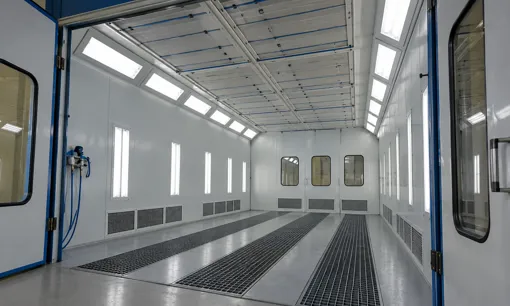
The paint booth is the heart of the application process and must be sized with great care. It is not enough for the parts to simply “fit”: inside the booth must ensure proper airflow, uniform coating distribution, and safe working.
A booth that is too small can compromise finish quality, while one that is too large increases energy consumption. Finding the right balance enables high performance without waste.
Drying and curing ovens
Ovens represent one of the most critical components of the entire system. Their size depends on the dwell time required to achieve proper drying or curing of the coating product.
Oven length, operating temperature, and thermal insulation must be designed to match the line speed. An error at this stage can compromise final quality and result in waste.
Energy efficiency and sustainability
Today, coating system sizing cannot overlook energy consumption. Energy optimisation has become a competitive factor, as well as an environmental one.
Solutions such as heat recovery, smart airflow management, and the use of high-efficiency technologies can significantly reduce operating costs while improving the sustainability of the coating system.
Sizing errors to avoid
Many issues arise from an incomplete analysis phase. Common errors include underestimating future production volumes, failing to account for actual cycle times, and selecting technologies unsuited to the specific manufacturing process.
Overlooking the potential for future expansion can also prove to be a significant limitation in the medium term. A facility should be designed to evolve alongside the company.
A tailored approach makes the difference
There is no universal coating system that meets the needs of every production environment. Each project requires a thorough assessment of specific production requirements, available space, and business goals.
A customised approach is essential to designing a truly efficient coating system that delivers consistent quality, uninterrupted production, and optimised operating costs.
Sizing a coating system means designing a well-balanced setup in which every component contributes to the final result. From the type of parts to energy consumption, every decision affects the system’s overall performance.
Working with specialised partners helps prevent design errors and enables the development of tailored solutions that support the company’s growth and continuous improvement.
Linea Eco Air designs customised solutions for every production requirements, ranging from coating systems for small components to technologies dedicated to complex sectors such as automotive, rail, and industrial vehicles (trucks and heavy-duty vehicles).
Contact us for a no-obligation quote.